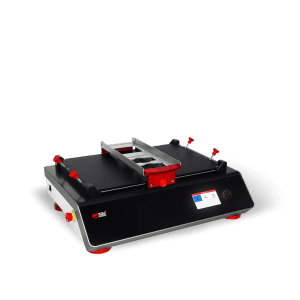
Taber provides original abrasive wheels specifically engineered and standardized to various grades for a wide range of applications. These wheels feature a proprietary formulation developed and designed by Taber Industries. During use, the binder material intentionally breaks down, continually exposing a fresh abrasive surface. The minimum usable diameter for Taber wheels is 44.4 mm, which varies depending on the wheel type.
Taber Abrading Wheels Are Categorized As Follows:
Calibrase®: A resilient wheel composed of an elastomeric binder and aluminum oxide or silicon carbide abrasive particles. Commonly used for evaluating rigid specimens.
Calibrade®: A non-resilient wheel made with a vitrified clay binder and silicon carbide or aluminum oxide abrasives. Typically used for flexible specimens.
Specialty: Designed for specific or custom applications.
Both Calibrase® and Calibrade® wheels are available in various grades to meet different abrasion requirements. The construction of original Taber wheels is carefully selected to produce normal wear patterns during operation. Their quality and consistency are ensured through ongoing sampling and tight manufacturing controls.
Wheels are sold in matched pairs and shipped in protective containers to avoid damage. Each wheel is marked as LEFT HAND or RIGHT HAND to ensure proper reassembly if removed. The minimum usable diameter is also printed on the label; wheels should be replaced when worn down to that diameter.
Depending on the material being tested and the abrasive type, specimen debris may transfer to the wheel surface, potentially causing clogging and altering the wheel’s effectiveness. For this reason, wheels should be frequently cleaned, and only handled by the edges to avoid contamination from oils or other substances.
The service life of a Taber wheel set depends on several factors, including the abrasiveness and texture of the test material and how frequently the wheels are resurfaced.
Most published test methods clearly state the required abrasive wheel type. If following a specific standard, refer to its specifications. However, if there is no defined test procedure, the best approach is to trial test wheels on your material. The optimal wheel selection should simulate real-world wear conditions as closely as possible.
Note: Abrasion is a complex phenomenon, and no accelerated wear test can fully replicate real-world wear. Abrasive wheels represent only a subset of the actual contact conditions your product may encounter in use.
To determine the best test method for your product or material, refer to the relevant links below.
>> Taber Test References (By Application)
>> Taber Test References (By Method)
| Calibrase Wheels | |
|---|---|
| CS-8 Calibrase: | A durable wheel designed to operate under loads of 250 or 500 grams, offering a mild abrasive action. Resurface using S-11 resurfacing disc. |
| CS-10F Calibrase: | A durable wheel designed to operate under loads of 250 or 500 grams, providing a mild abrasive action. CS-10F is commonly used for testing materials such as safety glazing materials and transparent plastics, and should be resurfaced using the ST-11 resurfacing stone. |
| CS-10 Calibrase: | This durable wheel provides a mild to medium abrasive action, similar to that produced by normal use, cleaning, or polishing. This popular wheel can be used to test a variety of materials including organic coatings, plastics, textiles, leather, and paper products. Resurface with the S-11 resurfacing disc. |
| CS-10P Calibrase: | This wheel has the same wear rate as the CS-10, but the CS-10P is designed to prevent the surface from recovering when testing paper products. It is used for short-term tests (e.g., 100 cycles) and requires resurfacing after every 10 tests. |
| CS-10W Calibrase: | This wheel is the white version of the CS-10. It is designed to prevent any color transfer from the wheel to the test material. |
| CS-17 Calibrase: | Compared to the CS-10 wheel, the CS-17 produces a harsher abrasion. Typically operated under 500 or 1000 gram loads, this wheel is used to test materials such as anodized aluminum, powder coatings, ceramics, plastics, and enamel. Resurface with the S-11 resurfacing disc. |
| Warning: Calibrase wheels MUST NOT BE USED after the printed expiration date on the wheel due to possible deterioration. | |
| Calibrade Wheels | |
|---|---|
| H-10 Calibrade: | A vitrified, non-resistant wheel designed to measure the wear resistance of steel and iron alloys. It is also used to assess the effects of hardening and tempering processes on steel and other ferrous materials. |
| H-18 Calibrade: | This commonly used non-resistant wheel provides a moderately coarse abrasion. It is typically used to test resilient materials such as non-adhesive rubber, certain woven fabrics, coated fabrics, and flexible plastic films. |
| H-22 Calibrade: | This wheel produces a coarse abrasion effect. It is used for testing rubber, linoleum, leather, deep-pile fabrics (such as automotive floor coverings), and concrete. |
| H-38 Calibrade: | It is a non-resistant, vitrified wheel composed of fine abrasive particles. Designed to operate under loads of 250 or 500 grams, its primary use is for testing woven and non-woven fabrics. It should be resurfaced using the Taber Wheel Resurfacer and a multi-point diamond tool. |
| Note: Calibrade wheels do not have expiration dates. | |
| Special Wheels / Abrasers | |
|---|---|
| CS-0 Rubber (same as S-32): | A non-resilient, vitrified wheel designed to measure the wear resistance of steel and iron alloys. It is also used to assess the effects of hardening and tempering processes on steel and other ferrous materials. |
| CS-5 Felt: | This commonly used non-resilient wheel provides moderate coarse abrasion. It is typically used to test resistant materials such as non-adhesive rubber, certain woven fabrics, coated fabrics, and flexible plastic sheets. |
| S-35 Tungsten Carbide: | This wheel produces a coarse abrasion effect. It is used for testing rubber, linoleum, leather, deep pile fabrics (such as automotive floor coverings), and concrete. |
| S-39 Leather: | This wheel is used together with a Grit Feeder for three-body abrasion tests and includes a leather strip bonded to the outer surface of a brass hub. |
| Aluminum Wheel: | A robust aluminum wheel that can be used alone or for applying abrasive strips. |
| S-33 Sandpaper Strip: | Pressure-sensitive adhesive-coated closed coating sandpaper, cut into 12.7 x 60 mm strips, designed to be attached around the circumference of CS-0 (S-32) wheels. The S-33 consists of extra-fine aluminum oxide particles graded 360 FEPA, with an average particle size of 40.5 µm (0.00159 inches). The paper has a weight of “A” grade, meeting the requirement of 70 – 100 g/m² paper weight. To maintain abrasion rate, the sandpaper strips should be replaced after a specific number of test cycles (typically 200 or 500). Applications of S-33 include vitreous and porcelain enamels, paints, metallic coatings, and furniture surfaces. |
| S-42 Sandpaper Strip: | Pressure-sensitive adhesive-coated closed coating sandpaper, cut into 12.7 x 60 mm strips, designed to be attached around the circumference of CS-0 (S-32) wheels. The S-42 consists of extra coarse aluminum oxide particles graded 180 ANSI-CAMI, with an average particle size of 78 µm (0.00304 inches). The paper has an “A” weight, meeting the requirement of 70 – 100 g/m² paper weight. To maintain abrasion rate, the sandpaper strips should be replaced after a specific number of test cycles (typically 200 or 500). Applications of S-42 include high-pressure decorative laminates, wood flooring, plastics, furniture surfaces, and varnishes. Warning: Due to possible degradation affecting abrasion rates, S-42 sandpaper strips must be stored in a temperature- and humidity-controlled environment. |