
Dippomat® – Immersion Corrosion Test Chamber
Automatic immersion and withdrawal cycles • Three separate sample support shafts • EN 3212 and ISO 15710 tests


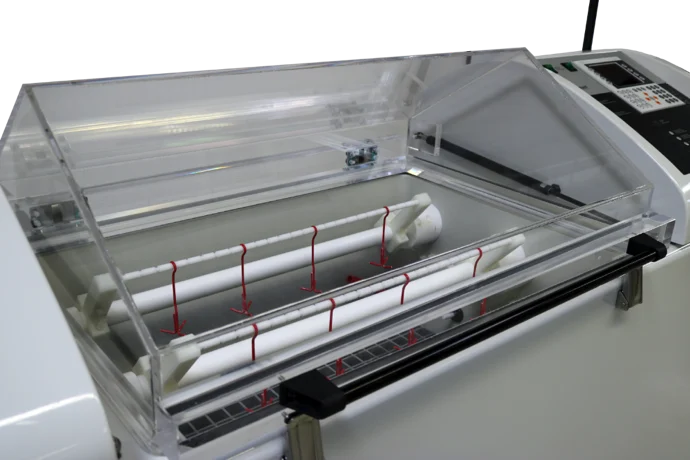
Liebisch Dippomat® is a specially designed immersion corrosion test chamber that creates alternating wet and high-humidity test conditions by immersing coated test samples in a buffered sodium chloride solution and withdrawing them at defined intervals.
The patented chest-type system was developed specifically for alternating immersion tests to evaluate the corrosion protection provided by paint and varnish systems applied to aluminium and aluminium alloys.
During testing, samples are fully immersed in the salt solution for specified periods, then withdrawn and exposed to the high-humidity atmosphere inside the chamber. The programmed immersion and withdrawal cycles repeat automatically throughout the test period.
What Applications Is Dippomat Used For?
Dippomat can be used to evaluate the following products and coating systems, and support related testing activities:
- Aluminium and aluminium alloys
- Paint and varnish systems on aluminium surfaces
- Coatings used in the aerospace industry
- Protective primer and topcoat systems
- Scribed coated test panels
- Surfaces exposed to alternating wetting and high humidity
- Comparative resistance testing of multiple coating systems
- Product development and quality control studies
The test method is particularly intended to compare the protective performance of paint systems used in aerospace applications under changing environmental conditions and exposure to saline environments.
What Is an Alternating Immersion Corrosion Test?
In an alternating immersion test, the sample is not kept continuously in the solution. Instead, two main stages are performed in sequence:
- Immersion stage: The coated sample is fully immersed in a buffered sodium chloride solution.
- Withdrawal stage: The sample is withdrawn from the solution and exposed to the warm, high-humidity atmosphere inside the test chamber.
This cycle continues automatically according to the duration and number of repetitions specified in the test programme.
During immersion, the salt solution comes into contact with the coating surface and the scribed area. During withdrawal, the thin film of solution remaining on the surface is exposed to the warm, humid atmosphere.
Alternating wet and high-humidity conditions help evaluate:
- The coating’s barrier properties,
- Corrosion progression around the scribe,
- Underfilm corrosion,
- The tendency for blistering and delamination,
- Performance differences between paint systems.
This test is not a variation of continuous salt spray testing, but a separate method based on the controlled immersion of samples in a salt solution and their subsequent withdrawal.
How Dippomat Works
The Dippomat test chamber contains three drive shafts fitted with sample support assemblies. Test panels are attached to these shafts using suitable holders.
The test sequence is as follows:
- The prepared buffered sodium chloride solution is poured into the respective solution reservoirs.
- Coated test panels that have undergone the required preparation are secured in the sample holders.
- Immersion and withdrawal times are programmed according to the test standard.
- The drive system lowers the samples into the solution reservoirs.
- The samples remain fully immersed for the specified period.
- Once this period has elapsed, the samples are automatically withdrawn from the solution.
- The samples are exposed to the high-humidity atmosphere inside the chamber.
- The immersion and withdrawal cycle repeats until the end of the test.
The three separate shafts allow different sample groups to be moved within the chamber in an organised and controlled manner. Shaft programming and simultaneous operation options should be determined in conjunction with the selected chamber control system and test application.
Applicable Standards
ISO 15710 – Alternating Immersion and Withdrawal Test
ISO 15710 defines an alternating immersion and withdrawal method used to evaluate the corrosion protection provided by paint and varnish coatings on aluminium and aluminium alloys.
A controlled scribe is made in the coated panel. The sample is then alternately immersed in and withdrawn from a dilute, buffered salt solution.
Under standard test conditions, samples are:
- Fully immersed in the solution for a specified period,
- Then withdrawn and held in a warm chamber atmosphere with high relative humidity,
- Subjected to this cycle repeatedly until the test duration is complete.
Unless otherwise specified, the basic cycle in ISO 15710:2002 consists of two hours of immersion followed by two hours in the withdrawn position. The chamber atmosphere is maintained at approximately 35 °C and above 80% relative humidity. However, test conditions should be verified against the current copy of the applicable standard and any supplementary information agreed between the parties.
The following are typically evaluated after testing:
- Corrosion progression around the scribe,
- Delamination of the coating from the surface,
- Blistering,
- Changes in appearance,
- The coating’s protective performance.
ISO 15710 testing is particularly useful for comparing the resistance of different paint or coating systems to alternating exposure to a salt solution.
EN 3212 – Corrosion Testing for Aerospace Coatings
EN 3212 defines a corrosion test for aerospace paints and varnishes involving alternating immersion in and withdrawal from a buffered sodium chloride solution.
The method is intended to evaluate the performance of coating systems used on aircraft and aerospace components under changing, salt-containing, high-humidity environmental conditions.
Dippomat’s automatic immersion mechanism and high-humidity test chamber allow the repeated immersion and withdrawal cycles required by this method to be carried out under controlled conditions.
Although EN 3212 and ISO 15710 share similar test principles, the standard designation, revision, sample preparation, solution, test duration, and evaluation criteria should be checked individually.
Operating Principle
The reliability of alternating immersion testing depends not only on chamber control but also on proper sample preparation.
The following information should be established before testing:
- Sample material and alloy type
- Surface pretreatment method
- Applied paint or coating system
- Number of coats and dry film thickness
- Curing and conditioning conditions
- Sample dimensions
- Scribing method and scribe geometry
- Test duration
- Evaluation criteria
The sample edges and rear surface should be sealed or coated according to the requirements of the standard and test plan. The scribe should be made through the coating system to the metal substrate in a controlled and repeatable manner.
Test panels must not come into contact with one another, the chamber walls, or the edges of the solution containers.
The chamber’s cleanliness should be checked before each test or any work involving a different coating system. During cleaning, the used test solution should be drained appropriately, the solution reservoirs cleaned, and the sample holders washed. The shafts and base plate should be inspected, corrosion products and coating residues removed, and the drainage system cleaned. This helps prevent the previous test from affecting the fresh solution.
Inadequate cleaning can alter the solution’s chemical composition, cause cross-contamination between sample groups, and compromise the comparability of test results.
The used solution should be drained and disposed of in accordance with its composition and the laboratory’s waste management procedures.
Dippomat’s control system automatically repeats the immersion and withdrawal stages.
Depending on the chamber configuration, the following parameters can be controlled or recorded:
- Immersion duration
- Withdrawal and high-humidity exposure duration
- Total test duration
- Number of cycles
- Test chamber temperature
- Error and interruption information
- Programme start and end times
Data logging, data transfer interfaces, and reporting options should be determined according to the selected control hardware.
Automatic execution of the test programme does not eliminate the need to check the solution regularly, verify sample positioning, and keep track of the current revision of the standard.
Which Laboratories Is Dippomat Suitable For?
Dippomat should be considered particularly for laboratories at:
- Aerospace paint and coating manufacturers
- Aluminium surface treatment facilities
- Aircraft and aerospace component manufacturers
- R&D centres developing coatings
- Independent testing facilities performing alternating immersion tests
- Organisations conducting quality control according to EN 3212 or ISO 15710
- Manufacturers carrying out comparative evaluations of different paint systems
Chamber selection should consider not only the standard designation but also sample dimensions, the number of panels to be tested simultaneously, the required solution volume, cycle times, and documentation requirements.
Which Chamber Should You Choose?
Dippomat does not spray the salt solution into the chamber as a mist. Instead, it lowers samples directly into the solution and then withdraws them. It is therefore not a general-purpose system that replaces conventional salt spray or cyclic corrosion test chambers.
Share your intended test standard, test cycle, sample dimensions, and required capacity with us so we can assess the necessary process systems and a suitable chamber configuration together.
Contact us for assistance with selecting the appropriate Liebisch process system and chamber, and for a technical quotation.
| Product | Description |
|---|---|
| Dippomat® | EN 3212, ISO 15710 Alternating immersion in and withdrawal from a buffered sodium chloride solution |


