
Custom Designed Corrosion Test Systems
Chamber design tailored to the sample • Custom loading and handling solutions • Application-specific test processes

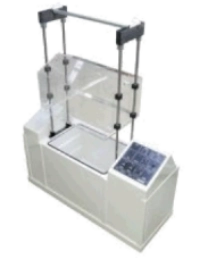
A standard corrosion test chamber may not accommodate every sample’s dimensions or arrangement, or meet the laboratory’s installation requirements. Large parts, irregularly shaped components, and special test setups may require modifications to the chamber’s mechanical structure or auxiliary equipment.
Liebisch can develop customized designs based on its standard models. Kar Kimya’s technical team works with Liebisch to assess application requirements and help identify suitable chamber and equipment options.
The scope of customization is determined on a project-by-project basis, taking into account sample characteristics, the intended test method, and the laboratory infrastructure.
When Might a Custom Design Be Required?
Before choosing a custom chamber, it is important to assess whether an existing model equipped with suitable accessories can meet the requirements. If standard options are insufficient, a custom design can be considered.
| Application Requirement | Design Considerations |
|---|---|
| Samples that cannot fit into a standard chamber | Usable test chamber dimensions and access opening |
| Long or irregularly shaped parts | Handling and positioning arrangements suited to the sample |
| Heavy samples | Load capacity, support points, and loading method |
| Access to samples from different directions | Lid or door geometry |
| External connections required during testing | Suitable cable feedthroughs |
| Compatibility with the laboratory’s existing discharge lines | Positioning of exhaust and drainage connections |
| Test cycles that cannot be achieved with standard options | Required processes and technical feasibility |
These considerations are intended for project evaluation. It should not be assumed that every option can be implemented in every chamber or retrofitted to an existing unit.
Custom Lids and Doors
Safe and convenient loading is just as important as ensuring that the sample fits inside the chamber. The lid opening, access direction, and available laboratory space should be evaluated together.
Liebisch’s custom design options include modified doors, lids, and handles. Selecting a suitable solution involves considering the sample’s loading path, operator access, and cleaning requirements.
Manufacturer Application Example: Vertically Lifted Transparent Lid
In a custom application published by Liebisch, a 400-litre salt spray chamber was modified with a transparent lid that can be raised vertically using a mechanical lifting mechanism. This design allows loading from two sides and observation of the samples from different directions, while increasing the test volume to 600 litres.
Sample-Specific Support and Positioning Arrangements
Holders designed for standard test panels may not be suitable for assembled parts or irregularly shaped samples. In such cases, custom carriers and support arrangements tailored to the sample can be considered.
Before design work begins, the sample’s dimensions, weight, centre of gravity, suitable support points, and position during testing should be established. Contact areas between the supports and the sample should also be considered in relation to the surfaces to be evaluated.
The aim is more than simply securing the sample. The positioning plan must also allow the test atmosphere to reach the relevant surfaces, ensure proper liquid drainage, and prevent samples from affecting one another.
Cable Feedthroughs and External Connections
Some test setups may require the sample to be connected to measurement or monitoring equipment outside the chamber. Suitable cable feedthroughs can be considered as part of the project for these applications.
The purpose of the connection, the number and diameter of cables, temperature conditions, and materials exposed to the corrosive atmosphere should be defined before design work begins.
The presence of a cable feedthrough does not automatically mean that the chamber is suitable for testing electrically powered samples. If powered operation is required, electrical safety, heat generated by the sample, and the necessary protective measures must be assessed separately.
Compatibility with Laboratory Infrastructure
The need for a custom design may arise from more than the sample itself. The laboratory’s physical conditions can also affect the chamber’s connections and placement.
Installation planning should consider not only the chamber’s external dimensions but also lid opening clearance, service access, the delivery route into the building, and the location of utility connections.
Any adaptation of the exhaust and drainage arrangements to the existing infrastructure must maintain the manufacturer’s operating and safety requirements. Compressed air, demineralized water, and electrical requirements should be determined according to the technical documentation for the selected chamber.
Let’s Assess the Right Design for Your Application
Share your intended test standard, test cycle, sample dimensions, and required capacity with us so we can assess the necessary process systems and a suitable chamber configuration together.
Contact us for assistance with selecting the appropriate Liebisch process system and chamber, and for a technical quotation.